

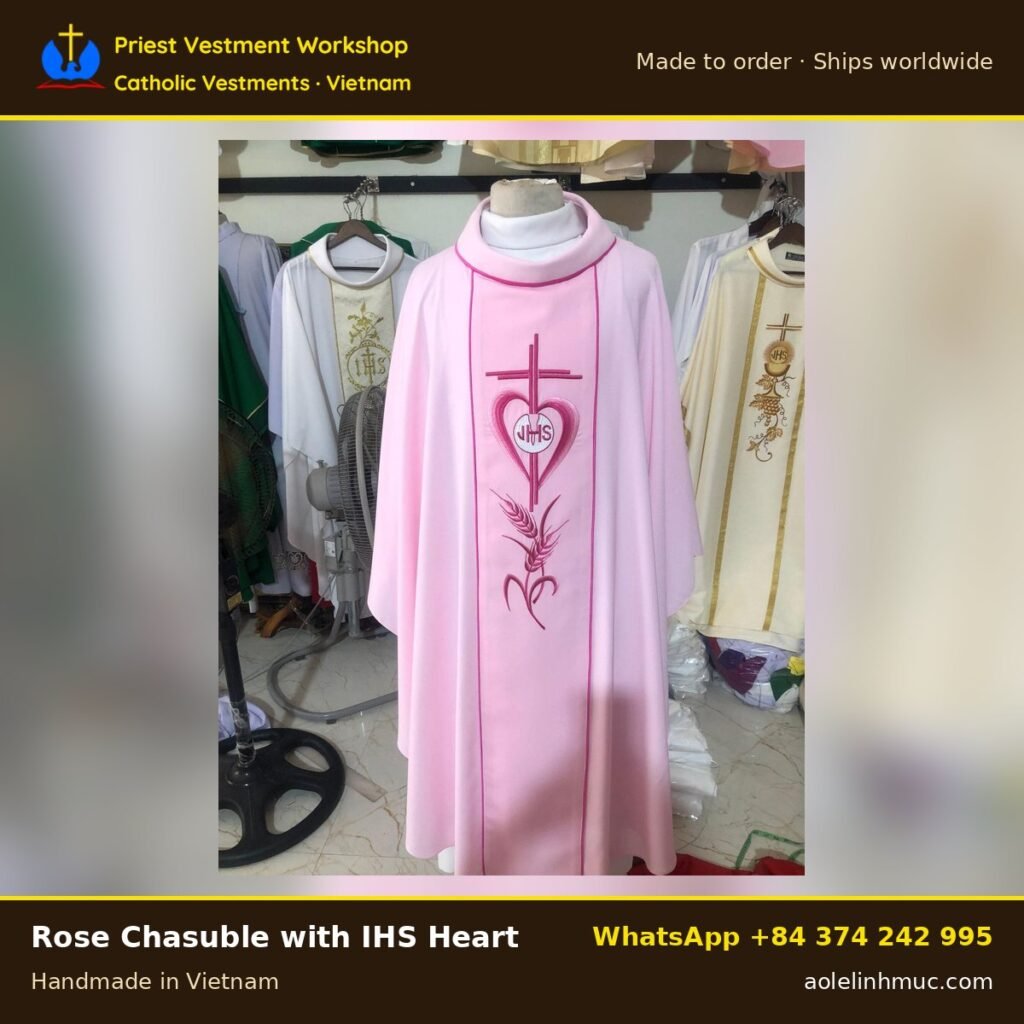
Many priests wear rose vestments for weddings, celebrating the Sacrament of Matrimony within Mass in rose. Is this practice correct? Below is a liturgical explanation by Fr. Joseph Pham Dinh Ai, SSS, translated from Vietnamese.
Question: May Rose Vestments Be Used for a Wedding Mass?
Many priests wear a rose chasuble to celebrate weddings (the celebration of the Sacrament of Matrimony within Mass). Is this practice correct?
Answer: No, Except on Gaudete and Laetare Sundays
No, unless the wedding falls on the Third Sunday of Advent (Gaudete Sunday) or the Fourth Sunday of Lent (Laetare Sunday). Here are several reasons.
1. The Church Prescribes White or the Color of the Day
The Church clearly states in no. 34 of the Order of Celebrating Matrimony (OCM): “When Marriage is celebrated within Mass, white vestments are to be used, or the liturgical color of the day, and the ritual Mass is celebrated.” Based on this norm, the instructions that follow it, and no. 372 of the General Instruction of the Roman Missal (GIRM), we understand the following:
(1) On days ranked 1–4 in the Table of Liturgical Days (that is, solemnities; the Sundays of Advent, Lent and Easter; and the days within the Octave of Easter), Mass must be celebrated with the texts and Scripture readings of that day and, naturally, in the vestments of that day, not in rose. For example, if the Rite of Marriage is celebrated during the Mass of the Solemnity of Sts. Peter and Paul (June 29), the priest or deacon must wear the red vestments of that solemnity, not rose; if it is celebrated during the Mass of the First, Second or Fourth Sunday of Advent, the priest or deacon must wear violet. OCM no. 34 adds: “On the Sundays of Christmas Time and Ordinary Time, when Marriage is celebrated within the parish community’s Sunday Mass, the Mass of the Sunday is used.” So if the wedding takes place during a Sunday Mass in Ordinary Time for the parish community, the priest or deacon must wear green, not rose.
(2) On other days ranked 5–13 in the Table of Liturgical Days (except the Sundays of Christmas Time and Ordinary Time, which rank 6), following the norm above, we may celebrate the ritual Mass, namely the Mass for the Celebration of Marriage with its own texts and Scripture readings (OCM no. 54), and the vestments must of course be white, not rose (OCM no. 34).
White expresses purity, holiness and the glory of God, like the garments of Christ at His Transfiguration, and it evokes the radiance of everything that touches God, like the garments of the angels and of the redeemed in the Book of Revelation. White also symbolizes the presence of the risen Lord in His Church and in His saints. For this reason, white is used in the Liturgy of the Hours and in Masses of Easter Time and Christmas Time; on celebrations of the Lord other than those of His Passion; on celebrations of the Blessed Virgin Mary, the Holy Angels and saints who were not martyrs; on the Solemnity of All Saints (November 1); the Nativity of St. John the Baptist (June 24); and the feasts of St. John the Evangelist (December 27), the Chair of St. Peter (February 22) and the Conversion of St. Paul (January 25) (GIRM 346a).
The Church also chooses white for the celebration of Marriage because white symbolizes joyful festivity. A wedding is indeed a sacred and joyful celebration. Weddings have traditionally been occasions when people gather to rejoice, eat, sing and dance, so much so that the Council of Laodicea (363–364 AD) forbade weddings during Lent (canon 53). The current Order of Celebrating Matrimony also notes: “If Marriage is celebrated on a day having a penitential character, especially during Lent, the pastor should advise the spouses to take into account the special nature of that day. The celebration of Marriage on Friday of the Passion of the Lord and Holy Saturday is to be avoided altogether” (no. 32).
2. Rose Is Reserved for Two Sundays of the Year
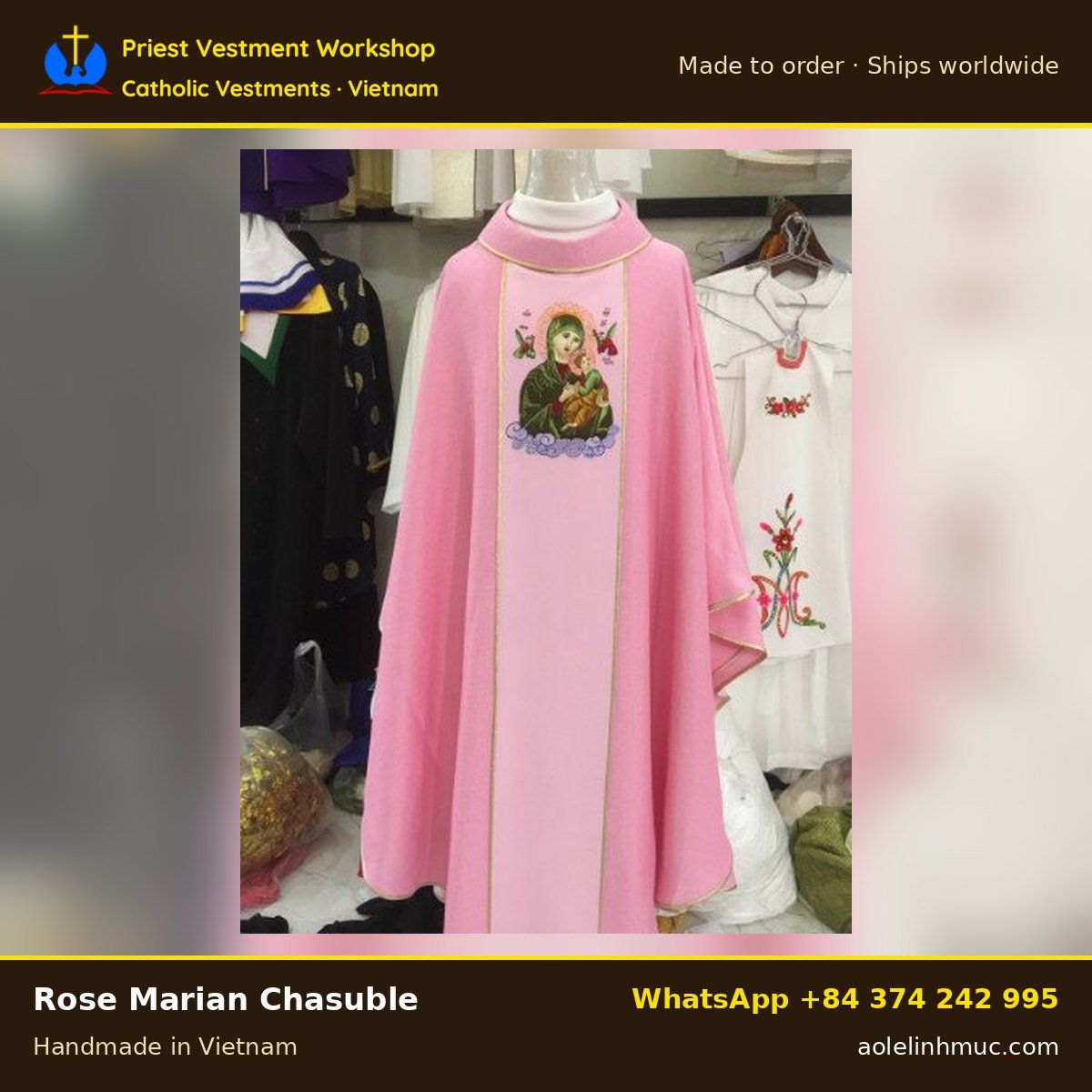
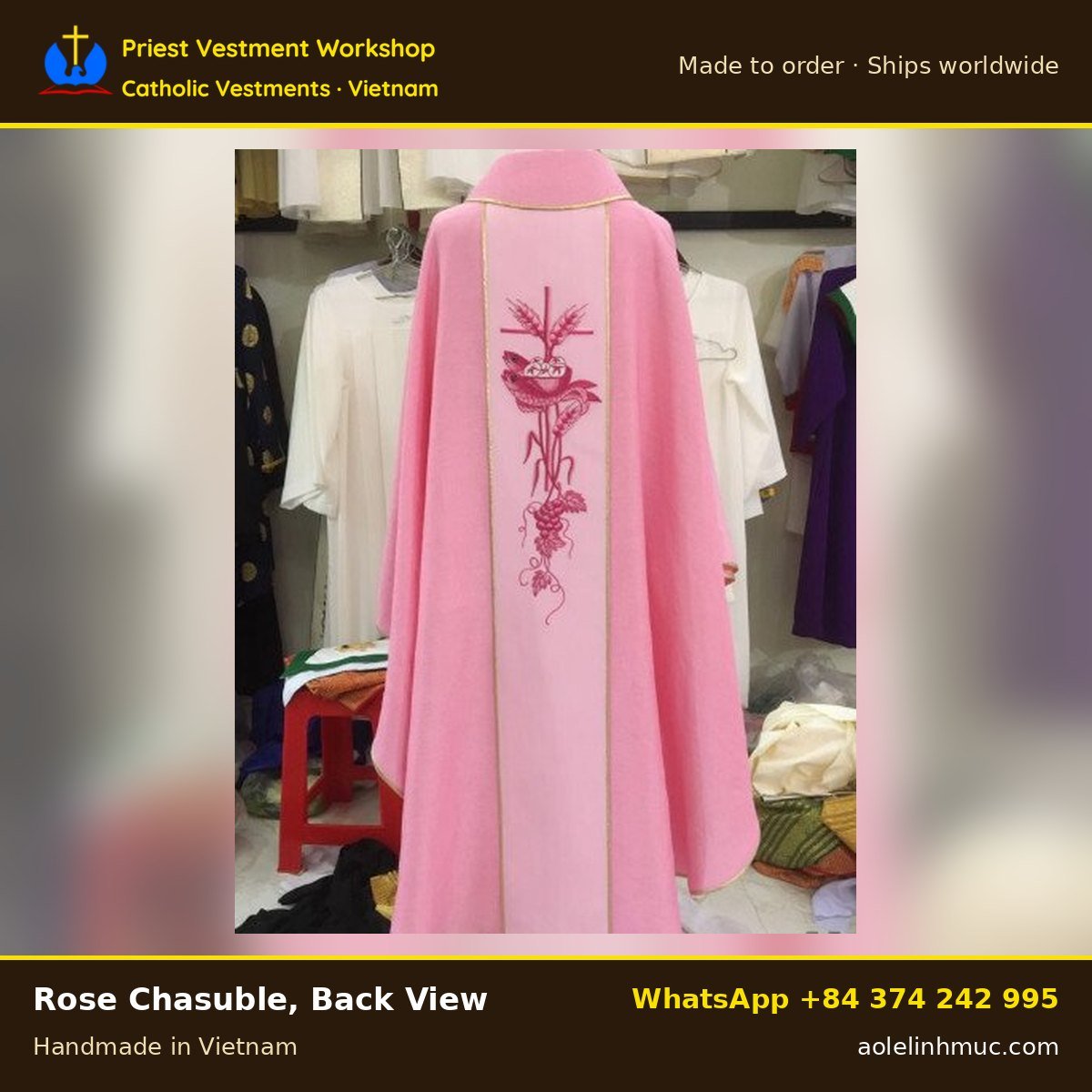
According to a tradition that has continued over many centuries, the Church explicitly allows rose to be used, in place of violet, on Gaudete Sunday (the Third Sunday of Advent) and Laetare Sunday (the Fourth Sunday of Lent) (GIRM 346f). The priest or deacon therefore wears rose vestments on only these two days of the entire liturgical year. Like white, rose expresses joy and gladness, but with one difference: this joy is not yet complete. It is certain and approaching, as the days of preparation for the great feast draw to a close, like the rose glow on the horizon at dawn announcing that bright daylight is coming.
These two Sundays are like a short rest along the long “violet” journey, a pause within the two penitential seasons of Advent and Lent once more than half of each season has passed. They give us fresh joy for the road ahead and a foretaste of the joy of Christmas and Easter Sunday, which the Church is preparing for and awaiting. On these two Sundays of joy, the violet of penance brightens into rose, but does not yet become the white of the solemnities of Christmas and Easter. This is why the GIRM (no. 305) teaches: “During Advent the floral decoration of the altar should be marked by a moderation suited to the character of this time of year, without expressing in anticipation the full joy of the Nativity of the Lord. During Lent it is forbidden for the altar to be decorated with flowers. Exceptions, however, are Laetare Sunday (Fourth Sunday of Lent), Solemnities, and Feasts.”
3. Overusing Rose Weakens the Meaning of Liturgical Colors
There are only two “rose Sundays” within the “violet seasons.” We are used to seeing violet throughout Advent and Lent, and then suddenly the color changes to rose on the Third Sunday of Advent and the Fourth Sunday of Lent. This change touches the senses and helps us grasp the meaning of the day and of the mystery being celebrated, exactly as GIRM no. 345 explains: “The purpose of a variety in the color of the sacred vestments is to give more effective expression even outwardly to the specific character of the mysteries of faith being celebrated and to a sense of Christian life’s passage through the course of the liturgical year.”
This change of color not only meets one of the standards of good celebration, which is to engage the senses, but also belongs to the art of liturgical celebration, so that the Mass does not become monotonous, impoverished or uninviting for those who take part. On the contrary, it helps us participate in the Mass “more consciously, actively and fully.” For this reason, constantly using rose vestments for every wedding throughout the liturgical year risks dulling the senses of the faithful, destroying the symbolism of liturgical colors and obscuring the specific character of the mystery being celebrated.
4. Rose Is Not the Liturgical Color of Love
Many people justify rose vestments at weddings by saying that pink is the color of love and happiness. In the liturgy, however, it is red that expresses strength, love and martyrdom. Compared with the explanations above, associating weddings with rose is a subjective interpretation. On the one hand, the regulation of the liturgy belongs to the authority of the hierarchy, so absolutely no one else, not even a priest, may on his own authority add, remove or change anything in the liturgy.
On the other hand, from a pastoral point of view, can we offer convincing reasons that rose vestments at weddings meet a genuine and worthy need and raise the quality of the celebration of Marriage? Or does the practice ultimately come from a secular reading of the color pink, from the long habit of “rose for every wedding,” or simply from the wishes of couples who do not want their wedding photos tied to the violet of Advent or Lent (cf. OCM no. 32)? With its authority to adapt the liturgy to local culture (Sacrosanctum Concilium 128; OCM nos. 39–44), the Bishops’ Conference has surely weighed the relevant reasons. Nevertheless, the current text of the Order of Celebrating Matrimony (approved by the Holy See in 2008) still states: “When Marriage is celebrated within Mass, white vestments are to be used, or the liturgical color of the day, and the ritual Mass is celebrated” (OCM no. 34).
Source: WHĐ, Catholic Bishops’ Conference of Vietnam (March 6, 2023), Fr. Joseph Pham Dinh Ai, SSS.
Looking for vestments in the correct liturgical colors? Browse our rose chasubles for Gaudete and Laetare Sundays and our white chasubles for wedding Masses.
Contact Our Vestment Workshop
We make chasubles in every liturgical color, tailored to each priest and shipped worldwide by EMS or DHL Express. Learn more about custom vestments.
- Workshop: Priest Vestment Workshop (Xưởng May Áo Lễ Linh Mục), Phu Nhai Church, Xuan Phuong, Xuan Truong, Nam Dinh, Vietnam
- WhatsApp: +84 374 242 995
- Phone/Zalo: +84 365 234 717
- Email: xuongmayaolelinhmuc@gmail.com
PRIEST VESTMENT WORKSHOP – CATHOLIC VESTMENTS, VIETNAM
“WE WORK WITH ALL OUR HEART”
Father, choir directors, youth and parish leaders: if you are looking for a workshop that specializes in Catholic vestments and uniforms, we sew chasubles, stoles, albs, clerical shirts, choir and altar server robes to order – with your chosen colors, fabrics and embroidery – and ship them worldwide. See our custom vestments.
Contact & orders:
WhatsApp: +84 374 242 995 · Email: xuongmayaolelinhmuc@gmail.com
Facebook: facebook.com/aolelinhmuc1 · Request a free quote